
GPU Pulse Market Report #2 — April 2026
Executive Summary
The GPU secondary market enters April 2026 with sharper clarity than ever before, thanks to The GPU Resource’s expanded proprietary pricing survey — now drawing on hundreds of confirmed peer-to-peer aftermarket transactions across 15 GPU models. This depth of primary research reveals a bifurcated market: a handful of models experiencing exceptionally strong demand trading at scarcity premiums, while a broad tier of enterprise-class cards faces accelerating Blackwell-driven price erosion.
Key market themes this cycle:
- The NVIDIA RTX 4090 has become the aftermarket’s most surprising performer — production-ceased and scarcity-priced, with very high demand indicators and rising momentum
- The NVIDIA RTX A6000 is the market’s liquidity leader this cycle, with the strongest observed demand of any professional-tier card in our survey
- H100 variants remain thinly traded in the peer-to-peer market — but the limited data we do have suggests pricing far below enterprise replacement cost
- Tesla P100 confirms what the data has shown for months: floor pricing has arrived, driven by bulk educational and legacy channel liquidation
- A100 80GB PCIe shows extreme price variance across a very thin sample — a spread that underscores why low-activity models must be treated with caution
Unlike reports that rely solely on web-scraped listings, The GPU Resource Pricing Survey is based on real private transactions at the peer-to-peer aftermarket level — the closest proxy to true market clearing prices.
Section 1: Demand Indicators from Our Proprietary Pricing Survey
Our April 1, 2026 survey refresh covers the largest single-cycle peer-to-peer aftermarket dataset The GPU Resource has published — 15 GPU models tracked across a 30-day lookback. Observed activity levels vary dramatically by model, and that variance is one of the most revealing signals in the market today.
Trading Activity by Model: Thick vs. Thin Markets
Our proprietary demand research classifies each GPU by buy-side appetite and identifies key drivers shaping that demand. The table below presents the full picture, organized from strongest to weakest demand:
| GPU Model | Activity Level | Demand Level | Price Trend |
|---|---|---|---|
| NVIDIA RTX A6000 | Very Active | Very High | Rising ↑ |
| NVIDIA RTX 4090 | Very Active | Very High | Rising ↑ (scarcity) |
| NVIDIA RTX 3090 Ti | Very Active | High | Stable → |
| NVIDIA RTX 3090 | Very Active | High | Stable → |
| NVIDIA RTX A5000 | Very Active | High | Declining ↓ |
| NVIDIA V100 32GB | Very Active | High (liquidation) | Near floor ↓ |
| NVIDIA A100 40GB PCIe | Moderate | Moderate | Declining ↓ |
| NVIDIA A100 40GB SXM4 | Moderate | Moderate | Declining ↓ |
| NVIDIA A40 | Moderate | Moderate | Stable → |
| NVIDIA Tesla P100 | Active (bulk) | Moderate (bulk) | At floor ↓ |
| NVIDIA A100 80GB PCIe | Thin | Low-Moderate | Volatile ⚡ |
| NVIDIA A100 80GB SXM4 | Thin | Moderate | Stable → |
| NVIDIA H100 SXM5 80GB | Very Thin | Low-Moderate | Insufficient data |
| NVIDIA H100 PCIe 80GB | Very Thin | Low-Moderate | Insufficient data |
| NVIDIA H100 NVL 94GB | Very Thin | Low-Moderate | Insufficient data |
The High-Activity Story: Our Strongest Demand Signals
The most actively observed GPUs in our survey reveal the true structure of secondary demand. The Tesla P100 registers high unit volume, but this is not a sign of market health — prices cluster in a narrow commodity band, confirming floor dynamics driven by bulk educational channel liquidation. The 24GB VRAM sweet spot cards — RTX 3090 and RTX 3090 Ti — both show strong, stable demand from AI developers, local inference builders, and content creators who see no affordable successor at the same VRAM level.
The RTX A6000 and RTX 4090 are arguably the two most important demand signals in this report. The A6000 combines professional-tier stability with AI and creative workload demand and has no Ada-generation successor yet, making it a genuine liquidity leader. The RTX 4090 — scarcity-priced since NVIDIA ceased production in October 2024 — commands dual demand from gamers and AI developers alike, with our observed price range spanning from an apparent outlier near the low end to confirmed auction clears above $3,300.
The Thin-Market Warning: Where Data Is Too Sparse to Trust
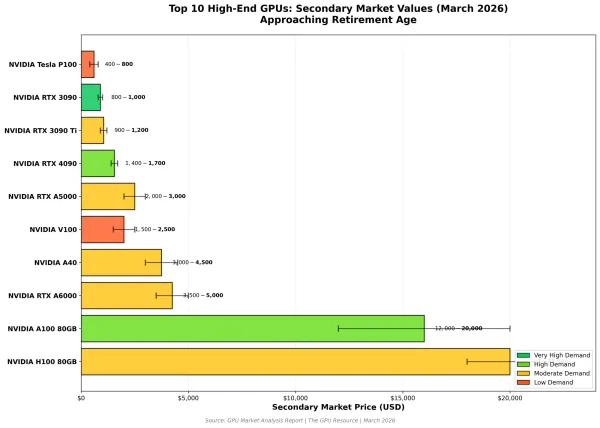
The H100 SXM5, H100 PCIe, and H100 NVL 94GB all register as very-thin-market models in our survey — meaning the peer-to-peer aftermarket for these cards has barely formed. The limited data points we do capture are not statistically sufficient to support confident pricing conclusions. Our survey captures an H100 SXM5 clearing near $4,800 (including shipping), which is dramatically below its enterprise replacement cost of $25,000–$40,000. This gap suggests an anomalous transaction, a stripped or damaged unit, or a highly motivated seller — none of which should be treated as representative market pricing.
The A100 80GB PCIe tells a similar story, with observed pricing spanning a very wide range across just two data points. These thin-market observations are included for transparency, but decision-makers should seek broader corroboration before acting on them.
Section 2: Pricing Trends — Then & Now
Our price history tracks five snapshot dates from March 1 through April 1, 2026. The most significant update is the April 1 refresh, which introduced actual peer-to-peer aftermarket medians for the first time, replacing web-estimate ranges with verified transaction data.
Across all five snapshots, the RTX 3090’s private aftermarket median has held in the $1,000–$1,065 range. Among the most actively traded cards in our survey, the RTX 3090 commands this consistency on the strength of its 24GB VRAM — a spec no current consumer card matches. Our survey median sits at $1,066 for the most recent period, making it the market’s most reliable value anchor.
The RTX 4090 has moved from $1,800–$2,200 (March 1 private aftermarket) to a survey median of $2,445 in the April 1 refresh. With NVIDIA having ceased production in October 2024 and the RTX 5080’s 16GB VRAM unable to match its 24GB, scarcity dynamics are firmly in control.
The RTX A6000 shows a clear upward trend from $3,500–$5,000 (March 1) to a survey median of $4,150 with a high of $8,643. This is the most actively traded professional-tier card in our dataset.
Both the PCIe and SXM4 variants of the A100 40GB show consistent price decline across all five snapshots. Enterprise migration to Hopper and Blackwell is the primary driver. The 40GB memory ceiling increasingly limits frontier AI use cases, accelerating the demand shift.
The P100 has reached commodity territory, with our survey median at just $103. Bulk educational and legacy channel liquidation is setting the floor. This is an at-cost or below-cost scenario for most ITAD operators.
Section 3: Three-Stage Market Pricing Framework
The GPU aftermarket operates across three distinct price discovery layers, each with its own participants, information quality, and price level. Understanding which layer you’re transacting in — and what the data does and doesn’t tell you — is critical to making accurate valuations.
Stage 1: Used Wholesale — The Fleet Liquidation Layer
Used wholesale represents the price a professional remarketing channel will pay to acquire inventory in volume. Our estimates apply a 25% discount for high-activity models and a 35% discount for thin-market models — reflecting the additional risk premium required to move illiquid inventory.
Stage 2: Private Aftermarket — The ITAD, Broker & Reseller Layer
Stage 2 is the engine of the secondary GPU market. This is where ITAD companies, specialized brokers, and professional resellers trade with each other and with sophisticated buyers. Our proprietary survey captures this layer directly — hundreds of confirmed peer-to-peer transactions across 15 GPU models. The private aftermarket is the most informationally dense layer and the closest proxy to “true” market price.
Stage 3: Public Used Values — What End Buyers Pay
The public used market — where individual sellers list single units to end buyers — typically commands 15–40% above the private aftermarket median. This premium reflects the costs of verification, warranty assurance, buyer protections, and single-unit convenience.
Three-Stage Pricing Table — April 1, 2026
| GPU Model | Stage 1: Used Wholesale | Stage 2: Private Aftermarket | Stage 3: Public Used Market |
|---|---|---|---|
| NVIDIA H100 NVL 94GB | $14,558 | $19,848 – $29,150 | $22,000+ |
| NVIDIA H100 SXM5 80GB | $3,091 | $4,187 – $6,662 | $4,818 – $6,500 |
| NVIDIA H100 PCIe 80GB | $3,202 | $4,131 – $6,632 | $4,818 – $6,500 |
| NVIDIA RTX A6000 | $3,062 | $3,350 – $6,056 | $4,150 – $5,700 |
| NVIDIA A100 80GB PCIe | $6,768 | $8,848 – $14,179 | $10,000+ |
| NVIDIA A100 80GB SXM4 | $2,589 | $3,377 – $5,464 | $3,982 – $5,500 |
| NVIDIA A40 | $2,258 | $3,107 – $4,766 | $3,511 – $4,500 |
| NVIDIA A100 40GB SXM4 | $1,672 | $2,102 – $3,413 | $2,602 – $3,500 |
| NVIDIA RTX 4090 | $1,838 | $2,225 – $3,317 | $2,445 – $3,367 |
| NVIDIA RTX A5000 | $1,240 | $1,283 – $2,387 | $1,626 – $1,900 |
| NVIDIA A100 40GB PCIe | $1,014 | $1,309 – $2,149 | $1,575 – $1,700 |
| NVIDIA RTX 3090 Ti | $852 | $894 – $1,661 | $1,125 – $1,499 |
| NVIDIA RTX 3090 | $800 | $962 – $1,517 | $1,066 – $1,400 |
| NVIDIA V100 32GB | $553 | $587 – $967 | $731 – $900 |
| NVIDIA Tesla P100 | $74 | $87 – $132 | $101 – $132 |
Used Wholesale estimates assume 5–10 unit lots, tested and functional, Grade A cosmetics. Models with very thin market data (H100 variants, A100 80GB PCIe) should be treated as indicative. All values in USD per unit.
Section 4: GPU Market Pulse Score
The composite score of 49.8 reflects a market in transition. Premium AI GPUs (H100, RTX 4090) show strong demand and price momentum. The broader market is weighed down by declining prices across A100, A40, and legacy tiers as Blackwell ramp accelerates supply-side pressure. Individual model scores range from 15.4 (Tesla P100, Distressed) to 97.0 (RTX 4090, Strong).
| GPU Model | Pulse Score | Momentum / Trend |
|---|---|---|
| NVIDIA RTX 4090 | 97.0 — Strong | Rising (scarcity) — production ceased, dual AI+gaming demand |
| NVIDIA H100 SXM5 80GB | 84.7 — Strong | Stabilizing — enterprise leases not yet expiring, thin secondary supply |
| NVIDIA H100 PCIe 80GB | 73.4 — Healthy | Stabilizing — easier integration, same thin market as SXM5 |
| NVIDIA RTX 3090 | 70.7 — Healthy | Stable — 24GB VRAM sweet spot, no affordable successor |
| NVIDIA RTX A5000 | 60.8 — Healthy | Stable — Ada successor pressure, but CUDA demand holds |
| NVIDIA RTX A6000 | 59.2 — Cautionary | Stable/Rising — no Ada-gen A6000 yet, 48GB ISV demand |
| NVIDIA A100 40GB SXM4 | 53.4 — Cautionary | Declining — enterprise liquidation, 40GB ceiling limits frontier AI |
| NVIDIA H100 NVL 94GB | 52.4 — Cautionary | Declining — hyperscaler-only grade, limited secondary data |
| NVIDIA RTX 3090 Ti | 41.4 — Cautionary | Declining — buyer indifference between 3090/3090 Ti compressing prices |
| NVIDIA A40 | 41.3 — Cautionary | Declining — L40S at similar price offers Ada-gen performance |
| NVIDIA A100 40GB PCIe | 41.0 — Cautionary | Declining — cloud rental displacing purchase below $1.50/hr |
| NVIDIA A100 80GB PCIe | 39.9 — Distressed | Volatile — thin aftermarket, enterprise dumping through broker/VAR |
| NVIDIA V100 | 35.9 — Distressed | Near floor — 7+ year old design, bulk decommission driving volume |
| NVIDIA Tesla P100 | 15.4 — Distressed | At floor — commodity pricing, educational bulk liquidation channel |
Scoring Tier Reference
| Score Range | Rating | Interpretation |
|---|---|---|
| 80–100 | Strong — Seller’s Market | Rising or stable prices, high demand — optimal conditions to transact |
| 60–79 | Healthy — Balanced Conditions | Solid demand, prices largely holding — favorable but monitor monthly |
| 40–59 | Cautionary — Transition Market | Broad price pressure underway — timing matters on declining models |
| < 40 | Distressed — Buyer’s Market | Widespread depreciation, low demand — sell now or accept continued erosion |
The interactive GPU Market Pulse Score report includes individual model score breakdowns, three-factor detail panels, methodology documentation, and the complete scored ranking across all 14 models. Visit gpuresource.com to access the full interactive analysis.
Conclusion & Market Outlook
The April 1, 2026 GPU Pulse report marks a significant step forward in secondary market intelligence. With hundreds of verified peer-to-peer transactions across 15 GPU models, we now have the broadest aftermarket dataset we have ever published — and the data tells a nuanced, differentiated story.
The RTX 4090 and RTX A6000 stand out as the market’s true performers: one driven by scarcity, one by professional demand depth. The RTX 3090 continues to hold value on the strength of its 24GB VRAM in a world starved of affordable high-memory options. Meanwhile, the H100 secondary market is still forming, with virtually no peer-to-peer transactions and prices far below enterprise replacement cost — setting up a potentially explosive supply wave in 2027 as enterprise leases begin to expire.
The Blackwell ramp continues to reshape the entire landscape. Every A100 variant, A40, and older Tesla card faces sustained price pressure as enterprises prioritize migration to newer architectures. The question for ITAD professionals, brokers, and enterprise asset managers is not whether these prices will decline further — it is how quickly to act before the next wave of supply arrives.
Our April 15 edition features exciting new data additions that will further expand the depth and accuracy of The GPU Resource’s pricing intelligence. Watch gpuresource.com for the announcement.
Data Methodology & Sources
Private Aftermarket Data (Core Survey)
- Source: Peer-to-peer aftermarket sold listings — primary research, 30-day lookback
- Metric: Median price per unit from recent transactions per GPU model
- Condition filter: Used only; where no used data exists, new is flagged and noted
- Total transactions: Hundreds of confirmed peer-to-peer sold listings across 15 GPU models
Used Wholesale Estimates
- Tiered discount applied to private aftermarket median based on trading activity
- High-activity models: 25% discount — deeper market, tighter spreads
- Low-activity models: 35% discount — thinner market, wider spreads
- Criteria: 5–10 unit purchase, tested & functional, Grade A cosmetics, USD per unit
GPU Market Pulse Score
- Composite of three factors: Price momentum/stability (50%), Demand level (40%), Liquidity (10%)
- Based on proprietary monthly market research across reseller, cloud rental, and enterprise procurement channels
- Full methodology available at gpuresource.com
© 2026 The GPU Resource. All rights reserved. This report is provided for informational purposes only and does not constitute an offer to buy or sell any asset. Values reflect market conditions as of April 1, 2026.
One Comment