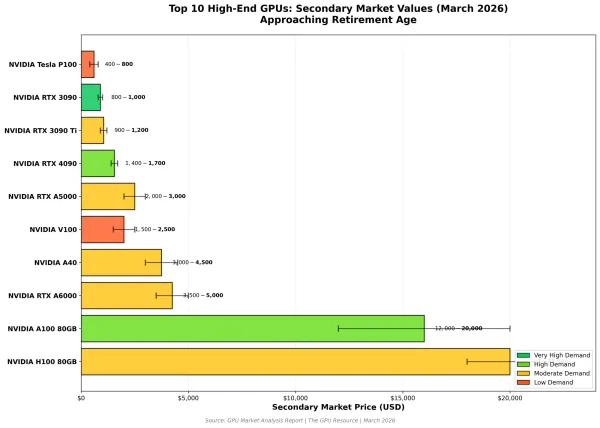
GPU Pulse Market Report #1 — March 2026
Report Date: March 14, 2026 | Market Context: Post-Blackwell Launch, HBM Memory Shortage, Enterprise Migration Cycle
Executive Summary
The high-end GPU secondary market in March 2026 is experiencing a significant transition as enterprises migrate from Ampere-generation hardware (A100, RTX 30-series) to newer Hopper and Blackwell architectures. This creates substantial opportunities in the secondary market for GPUs that are 3-5 years into their lifecycle—the typical retirement age for datacenter and professional workstation hardware.
Key Market Drivers
- HBM Memory Shortage: Driving up prices for memory-rich older GPUs (A100 80GB, RTX 3090 24GB)
- Blackwell Availability: Causing enterprise A100/H100 fleet liquidations
- AI Workload Migration: Smaller organizations acquiring retired enterprise GPUs for inference and training
- Depreciation Cycle: 2-year architecture refresh creating predictable resale windows
Top 10 High-End GPUs: Market Values & Retirement Analysis
1. NVIDIA A100 80GB (PCIe/SXM4)
Original Launch: 2020 | Typical Retirement Age: 4-5 years | Current Age: 5-6 years
| Metric | Value |
|---|---|
| Used Market Price (PCIe) | $12,000 – $18,000 |
| Used Market Price (SXM4) | $15,000 – $20,000 |
| Price Trend | ↓ Declining 15-25% YoY |
| Original MSRP | ~$10,000 (PCIe) / ~$15,000 (SXM4) |
| Depreciation Rate | 40-50% from peak |
Market Demand: HIGH — Still highly sought after for mid-sized AI training workloads (up to 70B parameter models), inference deployments where H100 is overkill, research institutions with budget constraints, and organizations building multi-GPU clusters.
Retirement Drivers: Enterprise upgrades to H100/H200, Blackwell (B200) availability pushing Hopper down-market, 3-5 year datacenter refresh cycles.
Secondary Use Cases: AI inference farms, academic research clusters, startup ML infrastructure, edge AI deployments.
2. NVIDIA RTX 3090 (24GB)
Original Launch: September 2020 | Typical Retirement Age: 3-4 years | Current Age: 5.5 years
| Metric | Value |
|---|---|
| Used Market Price (US) | $800 – $1,000 |
| Used Market Price (EU) | €747 (~$810) |
| Price Trend | → Stable (memory premium) |
| Original MSRP | $1,499 / €1,619 |
| Depreciation Rate | 47-53% from launch |
Market Demand: VERY HIGH — The “sweet spot” GPU for local AI development (LLaMA 2 70B, Stable Diffusion XL), 8K video editing and rendering, 3D artists requiring large VRAM, and budget-conscious ML engineers.
Key Advantage: 24GB VRAM at consumer price point—more memory than RTX 4070/5070 (12GB).
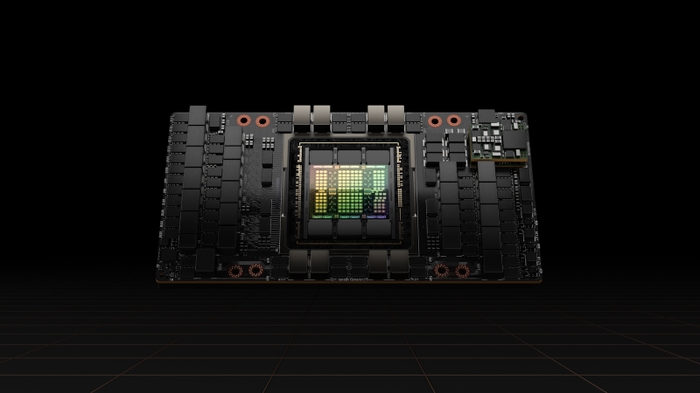
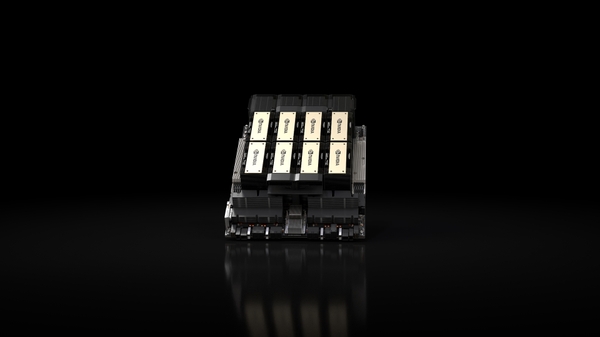
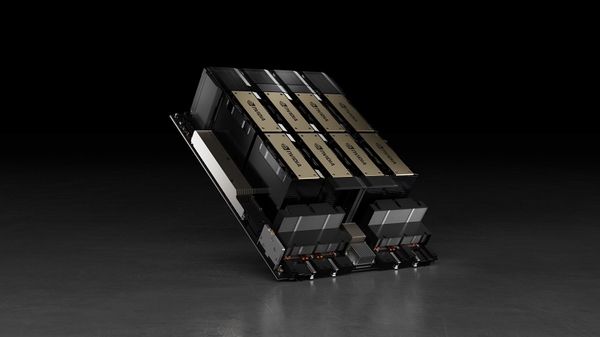
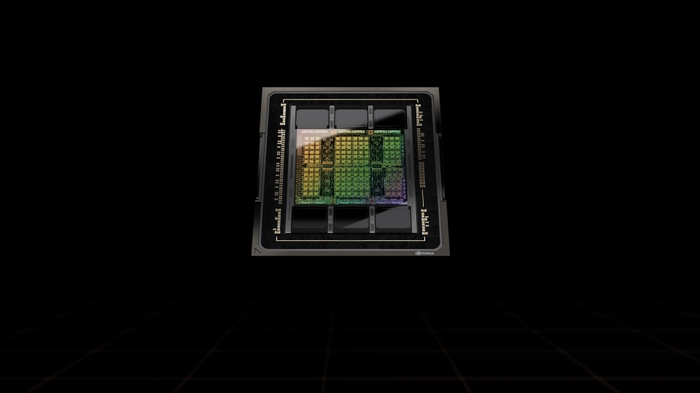
3. NVIDIA H100 80GB (PCIe/SXM5)
Original Launch: 2022 | Typical Retirement Age: 3-5 years | Current Age: 3-4 years
| Metric | Value |
|---|---|
| Used Market Price | $18,000 – $22,000 |
| Price Trend | → Stabilizing |
| Original MSRP | $30,000 – $40,000 |
| Depreciation Rate | 40-45% from peak |
Market Demand: MODERATE — Early retirement cycle: organizations upgrading to Blackwell B200, hyperscalers liquidating first-gen Hopper. Still premium pricing due to performance. Secondary uses: mid-tier cloud providers, enterprise AI inference, HPC clusters.
4. NVIDIA RTX A6000 (48GB)
Original Launch: 2020 | Typical Retirement Age: 4-5 years | Current Age: 5-6 years
| Metric | Value |
|---|---|
| Used Market Price | $3,500 – $5,000 |
| Price Trend | ↓ Declining steadily |
| Original MSRP | $4,650 |
| Depreciation Rate | 25-35% |
Market Demand: MODERATE-HIGH — Professional workstation replacement for CAD/CAM, medical imaging, scientific visualization, and professional 3D rendering. Secondary uses: small architecture firms, medical research labs, AI development workstations.
5. NVIDIA A40 (48GB)
Original Launch: 2020 | Typical Retirement Age: 4-5 years | Current Age: 5-6 years
| Metric | Value |
|---|---|
| Used Market Price | $3,000 – $4,500 |
| Price Trend | ↓ Declining |
| Original MSRP | ~$5,000 |
| Depreciation Rate | 30-40% |
Market Demand: MODERATE — Datacenter/virtualization focus for VDI deployments, multi-tenant GPU sharing, rendering farms, and AI inference servers. Migration to L40S (successor) is the primary retirement driver.
6. NVIDIA RTX 4090 (24GB)
Original Launch: October 2022 | Typical Retirement Age: 2-3 years | Current Age: 3.5 years
| Metric | Value |
|---|---|
| Used Market Price | $1,400 – $1,700 |
| Price Trend | ↓ Declining (RTX 5090 impact) |
| Original MSRP | $1,599 |
| Depreciation Rate | 12-15% |
Market Demand: HIGH — Gaming/prosumer sweet spot for high-end gaming rigs, AI development workstations, and local LLM hosting. RTX 5090 launch (early 2025) is the primary retirement driver.
7. NVIDIA V100 (32GB)
Original Launch: 2017 | Typical Retirement Age: 5-7 years | Current Age: 8-9 years
| Metric | Value |
|---|---|
| Used Market Price | $1,500 – $2,500 |
| Price Trend | ↓ Declining rapidly |
| Original MSRP | $8,000 – $10,000 |
| Depreciation Rate | 70-80% |
Market Demand: LOW-MODERATE — Legacy infrastructure only. V100 is approaching end-of-life; limited demand except for specific legacy use cases, educational institutions, and budget AI training on older models.
8. NVIDIA RTX A5000 (24GB)
Original Launch: 2021 | Typical Retirement Age: 4-5 years | Current Age: 4-5 years
| Metric | Value |
|---|---|
| Used Market Price | $2,000 – $3,000 |
| Price Trend | ↓ Declining |
| Original MSRP | $2,250 |
| Depreciation Rate | 15-30% |
Market Demand: MODERATE — Mid-tier professional workstation for design workstations, engineering simulations, professional video editing, and small-scale AI development.
9. NVIDIA RTX 3090 Ti (24GB)
Original Launch: March 2022 | Typical Retirement Age: 3-4 years | Current Age: 4 years
| Metric | Value |
|---|---|
| Used Market Price | $900 – $1,200 |
| Price Trend | ↓ Declining |
| Original MSRP | $1,999 |
| Depreciation Rate | 40-55% |
Market Demand: MODERATE — Marginal improvement over 3090 with same 24GB VRAM advantage. Similar use cases to RTX 3090 (AI development, content creation) with slightly better performance at a similar price point.
10. NVIDIA Tesla P100 (16GB)
Original Launch: 2016 | Typical Retirement Age: 5-7 years | Current Age: 9-10 years
| Metric | Value |
|---|---|
| Used Market Price | $400 – $800 |
| Price Trend | ↓ Declining rapidly |
| Original MSRP | $5,000 – $7,000 |
| Depreciation Rate | 85-90% |
Market Demand: LOW — P100 is essentially end-of-life with minimal commercial demand. Limited to extreme budget constraints, legacy code, educational/learning environments, and hobbyist projects.
Market Trends & Insights
Depreciation Patterns
- Consumer GPUs (RTX 30/40 series): 40-50% depreciation within 12 months of next-gen launch
- Professional GPUs (RTX A-series): 25-35% depreciation over 4-5 years (slower, more stable)
- Datacenter GPUs (A100, H100): 40-45% depreciation as next architecture launches
- Legacy GPUs (V100, P100): 70-90% depreciation after 7+ years
Memory Premium Effect
GPUs with high VRAM command premium pricing in the secondary market:
- 24GB cards (RTX 3090/3090 Ti): Holding value due to AI/content creation demand
- 48GB cards (A6000, A40): Strong demand from professional users
- 80GB cards (A100, H100): Enterprise-grade pricing, slower depreciation
Optimal Selling Windows
- Consumer GPUs: Sell 3-6 months before next-gen launch
- Professional GPUs: Sell at 3-4 year mark before major refresh
- Datacenter GPUs: Sell when next architecture enters volume production
Secondary Market Liquidity
| Liquidity | GPUs | Typical Time to Sell |
|---|---|---|
| High | RTX 3090/3090 Ti, RTX 4090, A100 80GB | 1-2 weeks |
| Moderate | RTX A6000/A5000, A40, H100 | ~1 month |
| Low | V100, P100, older Tesla/Quadro | 2-3 months |
Recommendations for Asset Managers
Immediate Action Items (Q2 2026)
- Liquidate V100/P100 inventory — Minimal remaining value, declining rapidly
- Hold A100 80GB — Still strong demand, prices stabilizing
- Sell RTX 3090/3090 Ti — Peak secondary market demand before RTX 50-series saturation
- Evaluate H100 retention — Consider renting vs. selling (2-4x revenue potential)
Pricing Strategy
- Price 10-15% below market average for quick sales
- Include benchmarks and documentation to increase sale price 10-20%
- Offer bulk discounts for enterprise buyers (8+ units)
- Consider rental options for H100/A100 (higher total revenue)
Risk Factors
- HBM shortage resolution could accelerate A100/H100 depreciation
- Blackwell volume production will pressure Hopper pricing
- RTX 50-series availability will impact RTX 30/40 series values
- AI market correction could reduce demand for older datacenter GPUs
Key Highlights
Remember: price ranges are dependent on your position in the aftermarket. Low end represents wholesale volume buyout pricing, while high-end represents retail or online single unit sales for premium product.
| # | GPU | Price Range | Demand |
|---|---|---|---|
| 1 | NVIDIA A100 80GB | $12,000–$20,000 | High |
| 2 | NVIDIA RTX 3090 | $800–$1,000 | Very High |
| 3 | NVIDIA H100 80GB | $18,000–$22,000 | Moderate |
| 4 | NVIDIA RTX A6000 | $3,500–$5,000 | Moderate-High |
| 5 | NVIDIA A40 | $3,000–$4,500 | Moderate |
| 6 | NVIDIA RTX 4090 | $1,400–$1,700 | High |
| 7 | NVIDIA V100 | $1,500–$2,500 | Low-Moderate |
| 8 | NVIDIA RTX A5000 | $2,000–$3,000 | Moderate |
| 9 | NVIDIA RTX 3090 Ti | $900–$1,200 | Moderate |
| 10 | NVIDIA Tesla P100 | $400–$800 | Low |
Data Sources & Methodology
This report synthesizes data from LevelUpBlogs GPU Market Analysis (March 2026), GPUnex Secondary Market Report (2026), Nomads Analytics Europe Price Tracker, industry analyst reports (TrendForce, Micron), and secondary market platforms including eBay, StockX, and specialized GPU marketplaces.
Price ranges reflect verified sales data (last 30 days), current marketplace listings, bulk transaction pricing, and condition-adjusted valuations (tested, working, with warranty).