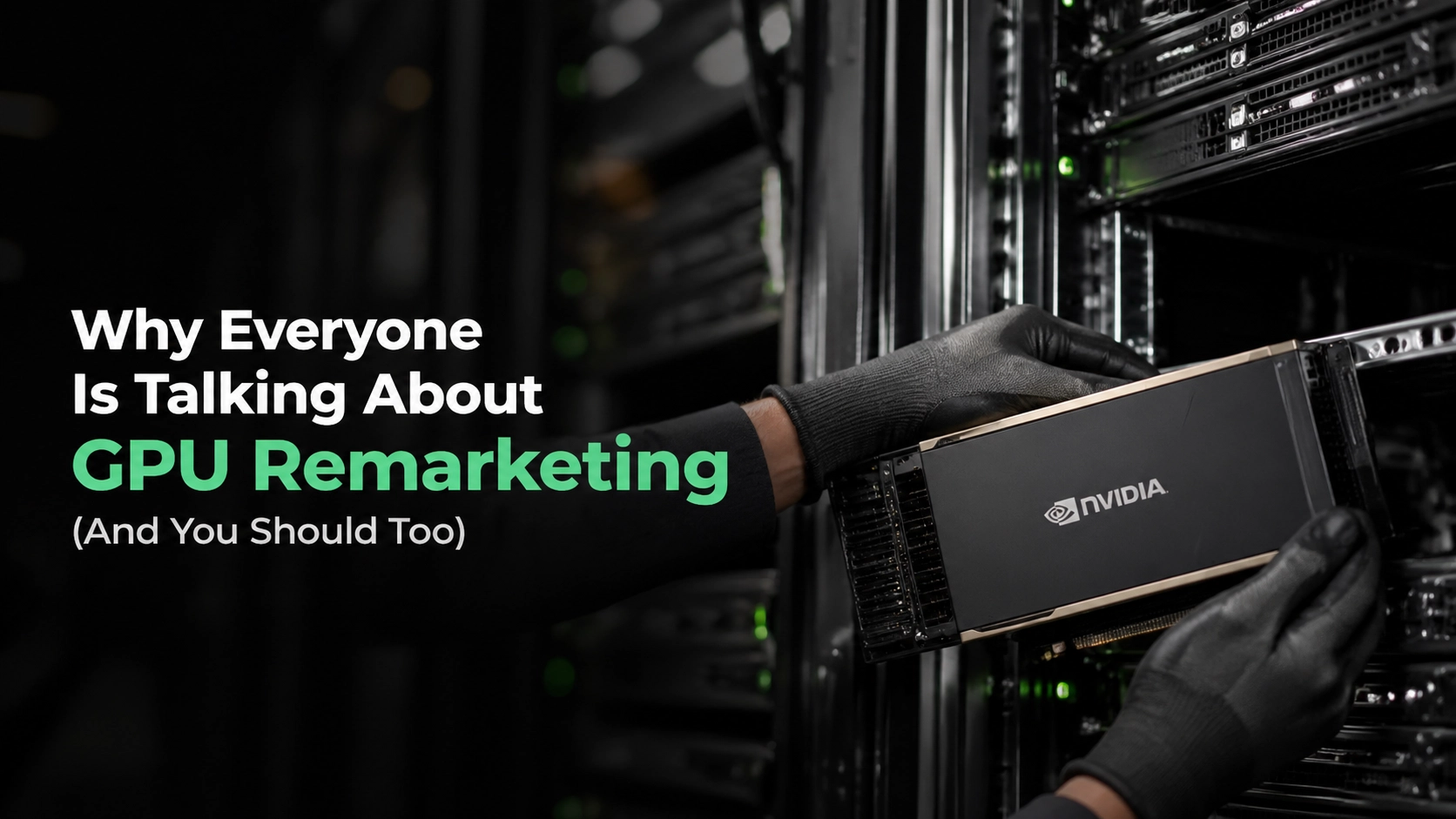
Why Everyone Is Talking About GPU Remarketing (And You Should Too)
The global AI infrastructure landscape is currently defined by a massive surge in capital expenditure, with hyperscalers and Tier-2 cloud providers investing hundreds of billions into silicon and high-speed interconnects. As NVIDIA transitions from the Hopper (H100/H200) architecture to the Blackwell (B200/GB200) generation, the conversation among data center operators and finance teams has shifted. The focus is no longer just on procurement, but on lifecycle management: specifically, GPU remarketing.
GPU remarketing is the strategic process of recovering value from existing compute assets: ranging from enterprise AI accelerators like the H100 to networking components: by reintroducing them into the secondary market. As lead times for new hardware fluctuate and the demand for inference-grade compute skyrockets, the second-life market for high-end silicon has become a critical pillar of the AI hardware supply chain.
The Economic Shift: From Depreciation to Asset Recovery
Historically, enterprise IT hardware followed a predictable depreciation curve. Standard server racks were often treated as "set and forget" assets, depreciated over three to five years with minimal residual value at the end of life. The AI supercycle has fundamentally upended this model.
Recent market data indicates that enterprise-grade AI accelerators are retaining between 60% and 80% of their original purchase price after two years of operation. In extreme cases, such as the H100 80GB modules, secondary market prices have occasionally approached 95% of original MSRP when supply-chain bottlenecks constrained the primary market. This high-value retention is why hyperscalers like Microsoft, Google, and Meta have extended their server depreciation schedules to six years, a move that collectively saves these firms approximately $18 billion annually.
For smaller cloud providers and enterprise data centers, this creates a significant opportunity for "fleet refreshes." By leveraging GPU Resource’s proprietary valuation tools, organizations can time their exits to maximize liquidity, using the proceeds from H100 sales to fund the CapEx required for B200 or specialized ASICs.
The Technical Cascade: Training to Inference
The primary driver of the robust GPU remarketing sector is the "value cascade" of the hardware itself. AI hardware requirements are not monolithic; they vary significantly depending on where a model is in its lifecycle:
- Frontier Model Training (Years 1-2): Requires the latest interconnects (800G/1.6T InfiniBand/Ethernet) and the highest HBM3e densities. This is the domain of the B200 and H200.
- Fine-Tuning and Inference (Years 3-4): This is where previous-generation hardware like the A100 and H100 finds a massive second life. Inference workloads are generally less compute-intensive than training, making used Hopper-class chips highly efficient for serving established models.
- Batch Processing and Academic Research (Years 5-6): Older enterprise cards provide cost-effective entry points for non-real-time workloads and research labs operating on constrained budgets.
By treating hardware as a multi-stage asset rather than a one-time purchase, operators can optimize their total cost of ownership (TCO). A system that is no longer competitive for training Llama-4 may be perfect for dedicated inference nodes. Understanding this technical hierarchy is essential for effective fleet refresh assessments.
Power Constraints as a Catalyst for Remarketing
While hardware performance is the headline, power density is the actual constraint in modern data centers. Many facilities are limited by their total megawatt (MW) allocation. As Blackwell systems demand significantly higher power per rack: often exceeding 100kW per cabinet: operators are forced to make a choice. To clear "power headroom" for new, high-density Blackwell clusters, they must decommission older, less efficient clusters.
This is where remarketing becomes a logistical necessity. Simply letting an A100 cluster sit idle is a waste of both power and floor space. Remarketing allows the operator to extract the final remaining value from those A100s, freeing up the power envelope and physical footprint for B200 deployments.

Addressing the ITAD Gap in the GPU Supply Chain
Traditional IT Asset Disposition (ITAD) firms are often ill-equipped to handle high-end GPU infrastructure. Most ITAD providers operate on a "scrap and commodity" mindset, focusing on the weight of precious metals or the resale of generic RAM and SSDs.
AI infrastructure requires a specialized approach. Remarketing an H100-based HGX baseboard or a liquid-cooled Blackwell rack involves:
- System Integrity Verification: Ensuring high-speed I/O (HSIO) and NVLink interconnects are fully functional and have not suffered thermal degradation.
- Secure Data Destruction: Certified erasure of any data residing on local NVMe drives within the GPU nodes, compliant with enterprise standards.
GPU Resource bridges this gap by offering specialized professional services that treat GPUs as high-value financial assets rather than generic electronics. Our approach prioritizes the technical "guts" of the system: focusing on networking speeds, optics, and semiconductor health: to ensure sellers receive a premium for their hardware.
Why Generic Valuation Methods Fail
Most organizations still use outdated spreadsheets to estimate the value of their hardware. These methods fail to account for the volatility of the GPU market, which is influenced by NVIDIA’s release cycles, TSMC’s CoWoS (Chip on Wafer on Substrate) capacity, and geopolitical export controls.
A generic estimate might undervalue an H100 cluster by 20% or more by ignoring the value of the 800G networking components or the specific OEM warranty status. At GPU Resource, we leverage real-time market data to provide granular industry analysis and precise valuations. This accuracy is the difference between a successful fleet refresh and a significant capital loss.
The Strategic Path Forward
As we move further into 2026, the secondary market will only grow in complexity. The introduction of Blackwell will release a significant volume of Hopper-based systems into the market. Organizations that act early: using data-driven remarketing strategies: will be the ones that maintain the highest margins.
Remarketing is no longer a niche activity for budget-conscious startups. It is a core strategic priority for any organization managing a GPU fleet. Whether you are looking to recover capital for your next upgrade or seeking to procure high-quality used compute for inference workloads, the transparency and liquidity of the secondary market are your greatest assets.
Key Considerations for Your Next Refresh:
- Timing: The 6-month window before a major architecture launch (like the B200) typically yields the highest recovery rates for current-gen hardware.
- Documentation: Maintain rigorous logs of thermal performance and usage hours to increase the resale value of your modules.
- Configuration: Systems sold as complete, verified units (e.g., 8-way HGX systems with InfiniBand) command significantly higher prices than individual modules. Consult our GPU configuration guide for optimization tips.
The AI hardware supercycle is moving at a pace that demands more than just procurement expertise. It requires a deep understanding of the second-life market and the tools to extract every dollar of value from your infrastructure stack.
For a comprehensive analysis of your current fleet’s market value or to connect with our network of buyers and sellers, contact our team of specialists. We provide the technical depth and market intelligence required to navigate the high-stakes world of GPU remarketing.
Contact info@gpuresource.com today for custom pricing requests and valuation services.